
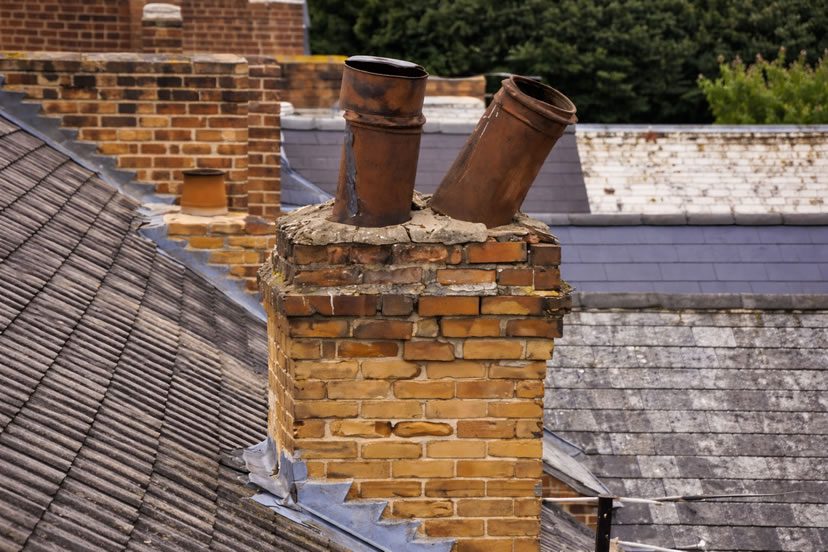

The fix is usually straightforward once a roofer has safe access: they re-bed or replace the pot and repair the flaunching around it. On this page you’ll learn why pots move, what to do right now, what repairs normally solve it, and how to get accurate quotes.
If you’re ready, you can request free, no-obligation quotes from local specialists.
Why a chimney pot moves in the wind
A chimney pot moves when something stops holding it tightly in place. Common causes include:
- Failed bedding mortar (the mortar that secures the pot has cracked and loosened)
- Cracked flaunching around the pot (top-of-stack mortar has broken up)
- Storm damage that shifted the pot or loosened fixings
- Freeze–thaw cycles that expanded small cracks over time
- A damaged or poorly fitted cowl that catches the wind and adds movement
- A deteriorating chimney stack where bricks/mortar around the pot have weakened
Often, movement starts small and then grows worse each time the wind blows.
Is a moving chimney pot dangerous?
It can be. A pot that moves can:
- fall onto the roof, break tiles/slates, and create a roof leak
- fall into a garden, driveway, or public area below
- crack more flaunching and let water into the stack
- loosen other components (cowls, caps, bird guards)
If the pot looks loose, treat it as a safety issue.
What to do right now (safety first)
- Keep people away from the area below the chimney
Don’t let anyone stand underneath it, and keep pets inside if possible. - Avoid using the fireplace/appliance (until checked)
Especially if you suspect the pot supports an active flue terminal or cowl. - Don’t try to secure it yourself
Roof access is risky, and a loose pot can shift unexpectedly. - Take a photo or short video from ground level
This helps roofers assess urgency and quote more accurately.
Moving chimney pot: common fixes (comparison)
| Problem | What you’ll notice | Typical fix |
|---|---|---|
| Bedding mortar failed | Pot rocks or twists | Re-bed the pot in fresh mortar |
| Pot cracked/damaged | Visible crack, broken edges | Replace the pot + re-bed |
| Flaunching cracked | Cracks around pot, missing mortar | Renew flaunching + secure pot |
| Cowl loose or catching wind | Rattling noise, cowl wobbling | Re-secure/replace cowl and fittings |
| Stack top failing | Loose bricks near pot | Brick repairs or partial rebuild, then re-bed pot |
Roofers often repair flaunching at the same time, because it supports the pot and sheds rainwater.
What’s involved in re-bedding or replacing a chimney pot?
A proper job focuses on stability, water run-off, and secure fittings.
1) Safe access
The roofer chooses ladders, a tower, or scaffolding depending on roof height, pitch and chimney position.
2) Remove loose material
They remove failed bedding mortar and any broken flaunching around the pot.
3) Re-bed or replace the pot
- If the pot is sound, they re-bed it securely in fresh mortar.
- If the pot is cracked or badly weathered, they replace it with a suitable new pot.
4) Renew flaunching with correct falls
They reform flaunching around the pots and shape it so rainwater runs away from the stack rather than pooling.
5) Secure cowls/caps/bird guards
If there’s a cowl or bird guard, they secure it properly or replace damaged fixings so it can’t rattle loose in high winds.
6) Clean-up and final checks
They remove debris and confirm the pot is stable and watertight.
How a moving pot can lead to leaks and damp
Once a pot moves, it often cracks flaunching. That then becomes a major entry point for rain. Water soaks into the top of the stack and can show up as:
- damp patches on chimney breasts
- stains near fireplaces
- loft damp near the stack
- accelerated brick and mortar deterioration
So, even if you haven’t seen leaks yet, fixing a moving pot early can prevent expensive damage.
Do you need scaffolding?
Not always. Some pots can be re-bedded safely using ladders or an access tower, especially on lower roofs. However, scaffolding may be needed on taller properties, steep roofs, or where the job involves multiple pots and extensive flaunching repairs.
What affects the cost?
Costs depend on:
- access method (ladders/tower/scaffold)
- whether the pot can be re-bedded or needs replacement
- how many pots are affected
- whether flaunching needs renewing
- whether cowls/caps need refitting
- roof height, pitch, and chimney position
Photos or a short video of the movement can help roofers quote accurately.
What to check before hiring someone
Ask for:
- a written scope (re-bed vs replace, flaunching included, cowl/bird guard included)
- access method and whether it’s included
- proof of public liability insurance
- before/after photos where practical
- warranty/guarantee terms
Get free quotes for a chimney pot moving in the wind
Use our enquiry form to request free, no-obligation quotes. Tell us what you’ve seen and add a photo or short video if you can. We’ll match your enquiry with suitable local specialists so you can compare options and choose the best fit.
Chimney pot moving in wind FAQs
Can I ignore a chimney pot that moves slightly?
It’s best not to. Movement often worsens over time and can lead to falling masonry and leaks. Arrange an inspection and repair.
What usually causes a moving pot?
Most commonly, the bedding mortar has failed or the flaunching around the pot has cracked. Storms and freeze–thaw cycles can accelerate the problem.
Is re-bedding enough or do I need a new pot?
If the pot is still sound, re-bedding often works well. If the pot is cracked or badly weathered, replacement is usually the better long-term option.
Can a loose pot cause damp on a chimney breast?
Yes. Movement often cracks flaunching and lets rain into the top of the stack, which can show up as damp or staining indoors.